On this page ▾
- How Mines works
- The real numbers
- Myth 1: "Start in the corners, mines avoid them"
- Myth 2: "After a mine appears, the next round is safe"
- Myth 3: "Cash out at 2x and you will always profit"
- Myth 4: "More mines are smarter because you only need one pick"
- Myth 5: "Betting patterns can beat it"
- What actually helps
- Strategy comparison
- Where to play, and what to check
- A quick experiment you can run
- Mines is a pure probability game; the house edge is baked into the multipliers.
- Click patterns, "hot" tiles and previous rounds do not predict anything.
- Your only real choices are mine count and when to cash out, and both only change variance.
- Test it free in our Mines simulator before risking anything.
Few games generate as many "secret strategies" as Mines. Forums, videos and group chats are full of patterns, systems and lucky-corner theories. We tested the popular ones against the underlying probabilities. This article is organised as a series of myths, each followed by the maths. You can follow along with our Mines simulator.
How Mines works
The typical version uses a 5x5 grid, 25 tiles, with a number of mines you choose. You reveal tiles one at a time. Each safe tile raises your multiplier, and you can cash out at any moment. Hit a mine and you lose the stake. The layout is fixed before you begin, based on a seed, which is why verification tools like the ones in our provably fair guide exist.
The real numbers
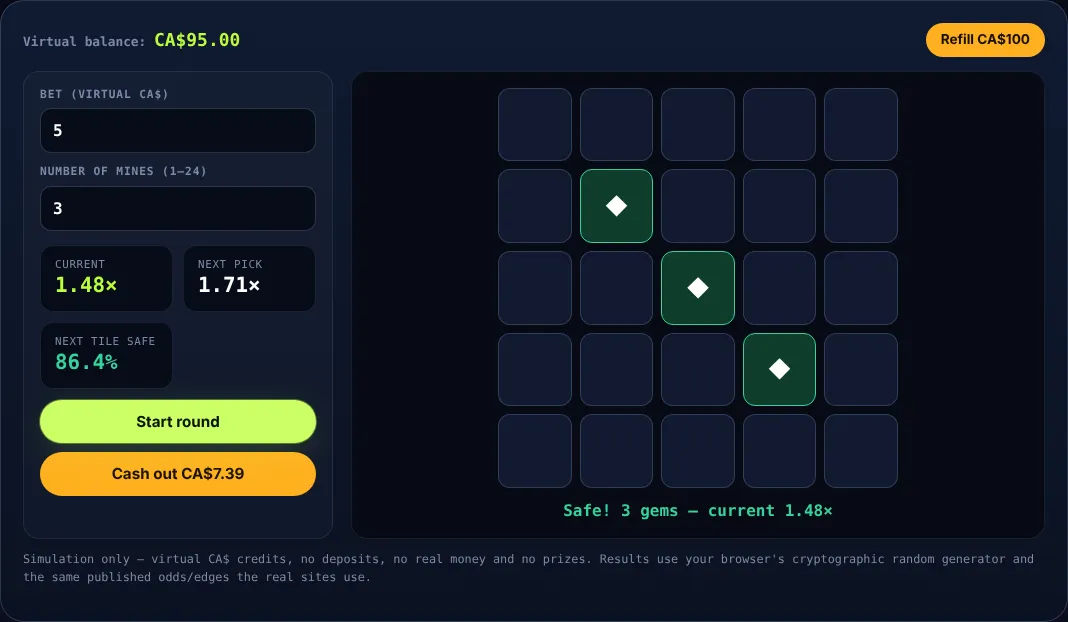
With 3 mines on 25 tiles, the chance each pick is safe is the number of safe tiles remaining divided by the tiles remaining. The cumulative chance of surviving n picks is the product.
| Picks | Chance of surviving | Fair multiplier (1 / chance) |
|---|---|---|
| 1 | 88.0% | 1.14x |
| 2 | 77.0% | 1.30x |
| 3 | 67.0% | 1.49x |
| 4 | 57.8% | 1.73x |
| 5 | 49.6% | 2.02x |
Check the first row: 22 safe tiles out of 25 gives 22/25 = 88%. Second pick: 21/24, so 0.88 x 0.875 = 77%. These are the numbers a fair game would pay. Real games shave the multiplier by the house edge, which varies by operator, often by a few percent. So a displayed 2.00x after five picks, where the fair figure is 2.02x, hides a small but permanent cost on every cash-out.
Myth 1: "Start in the corners, mines avoid them"
Fact: Every tile has the same chance. Layouts are generated randomly, so no region is safer. Any streak where a corner "worked" is a coincidence.
Myth 2: "After a mine appears, the next round is safe"
Fact: Rounds are independent. The previous layout has no effect on the next one. This is the gambler's fallacy, the same error behind "red is due" in roulette.
Myth 3: "Cash out at 2x and you will always profit"
Look at the table: surviving to about 2x with 3 mines takes five picks and happens roughly half the time. A strategy of repeatedly targeting 2x wins about half the rounds and, after the edge, loses slightly on average. You are essentially betting on a near-coinflip with a worse payout than fair. See our coinflip odds article for the same logic.
Myth 4: "More mines are smarter because you only need one pick"
Fact: More mines means a bigger first multiplier, but a higher chance of losing it immediately.
| Mines | Chance first pick is safe | Fair multiplier |
|---|---|---|
| 1 | 96.0% | 1.04x |
| 3 | 88.0% | 1.14x |
| 5 | 80.0% | 1.25x |
| 10 | 60.0% | 1.67x |
| 24 | 4.0% | 25.00x |
At 24 mines, one safe tile exists among 25. The 4% chance pays a fair 25x, so expected value is the same as any other setting before the house edge. You are simply choosing between frequent small results and rare large ones.
Myth 5: "Betting patterns can beat it"
Progressive systems, such as raising your stake after losses, change how much you risk, not the odds. See bankroll management for a sensible approach and why the Martingale idea is dangerous.
Key idea: Every mine count and cash-out target has roughly the same expected loss per unit wagered. Your choices adjust the shape of the ride, not the cost of the ticket.
What actually helps
- Decide your cash-out target before you start and stick to it, using auto-cashout if offered.
- Keep stakes small relative to your session bankroll, around 1% to 2%.
- Choose volatility on purpose. Low mines with few picks is calmer; high mines is a lottery.
- Verify fairness using the site's tools.
- Stop at your limit. Our bankroll calculator can help set one.
Strategy comparison
| Approach | Win rate | Typical payout | Variance | Beats house edge? |
|---|---|---|---|---|
| 1 mine, 1 to 2 picks | Very high | Tiny | Low | No |
| 3 mines, 5 picks | About 50% | About 2x | Medium | No |
| 10 mines, 1 pick | About 60% | About 1.6x | Medium | No |
| 24 mines, 1 pick | About 4% | About 24x | Extreme | No |
Where to play, and what to check
Mines is a staple "original" on many crypto-leaning casino sites rather than on classic skin sites. Before you play anywhere, read the site's fairness page and terms, and see our ranking of CS2 gambling sites and how we rate. Some platforms, such as CSGOEmpire, focus on roulette, cases and coinflip matches instead. If you are looking at an offer, check wagering rules first with the wagering calculator.

A quick experiment you can run
Open the simulator and play 200 rounds with 3 mines, always cashing out after five safe picks. You should win roughly half the rounds. Then repeat with a different pattern, such as always starting at the top row. The results will look nearly identical, apart from random noise. That is the clearest proof that tile choice does nothing and that only your mine count and cash-out point shape the outcome.
Frequently asked questions
Can you predict where mines are in the Mines game?
No. On a provably fair site, the layout is generated from a seed and cannot be guessed from patterns. Previous rounds do not predict the next.
What is the safest way to play Mines?
Fewer mines and fewer reveals mean lower variance and smaller payouts. There is no strategy that removes the house edge.
Do higher mine counts pay more?
Yes, because each pick is riskier. The multiplier rises to compensate, but the chance of busting rises as well.
Is auto-cashout a good idea?
It can help enforce discipline by cashing out at a target you set beforehand, but it does not improve the expected value.
Play responsibly: CS2 gambling is for adults 19+ (18+ in AB, MB, QC). Set limits, never chase losses, and use self-exclusion if it stops being fun. Free, confidential help: ConnexOntario 1-866-531-2600 or your provincial helpline — see our responsible gambling page.
Related reading
Case Battles Explained: Modes, Odds and Strategy for Beginners
Case battles turn case opening into a head-to-head contest. We explain the formats, the expected value and how to play without overspending.
Read article →
Crash vs Roulette: Which CS2 Game Fits Your Style?
Both games look simple, but they behave very differently. We compare odds, volatility and decision-making to help you choose.
Read article →
CSGOEmpire Roulette Tips: 9 Smart Habits for Canadians
Roulette is a pure game of chance, but your habits are not. Here are nine practical tips for playing CSGOEmpire roulette more sensibly.
Read article →