On this page ▾
- A fair flip is 50/50, but the platform fee creates a negative expected value.
- Edge depends on how the fee is charged: on the pot, or on the winnings only.
- Streaks do not predict the next flip; there are no due outcomes.
- Provably fair proves integrity, not profitability.
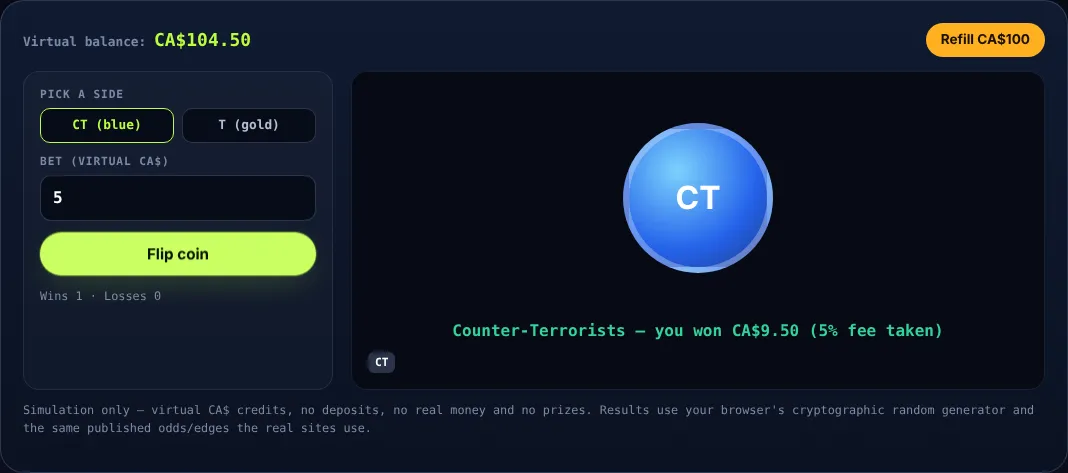
Coinflip looks like the simplest game in skin gambling: two sides, one coin, a clean 50/50. That simplicity makes it ideal for understanding the maths of the house edge. In this article we do the calculations in full, so you can see where the cost comes from and what it adds up to in CA$. If you want to feel it first, try our coinflip simulator.
The setup
In a typical skin coinflip, a player creates a game by wagering an item or balance on one side. Another player matches it, and the platform flips. The winner takes both stakes minus a fee. Platforms that offer this format include CSGOEmpire, which features coinflip-style matches alongside roulette and case opening. See how CS2 gambling works for the bigger picture.
Step 1: the fair odds
With a fair coin and equal stakes of CA$100 each, the pot is CA$200. A fair payout would give the winner exactly CA$200, so the expected value of one flip is:
EV = 0.5 x 200 - 100 = CA$0
No edge exists yet. The cost arrives with the fee.
Step 2: how the fee creates the edge
Platforms usually take a percentage of the pot or of the winnings. The way it is applied changes the maths.
| Fee model | Winner receives | Your EV per CA$100 stake | House edge on stake |
|---|---|---|---|
| No fee (fair) | CA$200 | CA$0.00 | 0% |
| 5% of the pot | CA$190 | -CA$5.00 | 5% |
| 5% of winnings only | CA$195 | -CA$2.50 | 2.5% |
| 10% of the pot | CA$180 | -CA$10.00 | 10% |
The calculation for "5% of the pot": 0.5 x 190 - 100 = -CA$5. For "5% of winnings only", the fee is 5% of the CA$100 profit, so the winner gets 200 - 5 = CA$195, giving 0.5 x 195 - 100 = -CA$2.50. Always find out which model your platform uses; the fine print on fees matters more than the 50/50 headline. Fees are set by each operator and can change.
Compare: A 15-slot roulette wheel (7 red, 7 black, 1 green) has a 6.67% edge on a 2x bet. A coinflip with a modest fee can be cheaper per bet than roulette, but the cost per hour depends on how often you play. See the roulette strategy guide.
Step 3: expected loss over many flips
The edge applies to every dollar wagered, not just your balance. Use total wagered, also called turnover, to estimate expected loss.
| Total wagered | Edge 2.5% | Edge 5% | Edge 10% |
|---|---|---|---|
| CA$100 | CA$2.50 | CA$5 | CA$10 |
| CA$500 | CA$12.50 | CA$25 | CA$50 |
| CA$2,000 | CA$50 | CA$100 | CA$200 |
| CA$10,000 | CA$250 | CA$500 | CA$1,000 |
These are expected values, not guarantees. In the short run, luck dominates; in the long run, the edge shows up reliably. A rakeback offer may soften the cost; see what is rakeback and use the rakeback calculator.
Variance: why short runs feel different
A flip is a binary outcome, so variance is high relative to the bet. Consider ten flips of CA$100 at 5% pot fee. Your expected loss is CA$50, but your actual result could swing anywhere between losing all ten (-CA$1,000) and winning all ten (+CA$900). The chance of winning at least six of ten is around 38% for a fair coin; with the fee, you are still slightly less likely to end ahead overall. The point: you can easily come out ahead in a short session, which is exactly why the edge feels invisible.
Myths we hear
"Heads came up five times, tails is due"
This is the gambler's fallacy. Each flip is independent. A streak says nothing about the next result.
"Matching opponents with big stakes improves my odds"
Stake size does not change the probability of the coin. It only changes the amount at risk.
"Provably fair means I will win more"
It means the outcome can be verified, not that the odds favour you. Learn how in our provably fair guide and how to verify a roll hash.
"Doubling after a loss guarantees a win"
The Martingale system risks catastrophic loss when a losing streak hits your balance cap. Even a 10-flip losing streak has a probability of about 0.1% for a fair coin, yet it appears often enough across many players. See bankroll management for sensible staking.
Skin valuation adds another layer
When you wager skins instead of balance, the platform assigns a coin value to each item. If that value is lower than the item's market price, you pay an extra hidden cost on top of the fee. Compare the pricing before depositing; our guide on depositing skins shows how. For converting site coins to dollars, use the coins-to-CAD converter.

Takeaways
- A coinflip is only as fair as its fee model.
- Expected loss equals turnover multiplied by the edge.
- Short-term variance is large and misleading.
- No pattern or system can change the expectation.
- Treat it as paid entertainment with a known cost.
Frequently asked questions
Is a skin coinflip really 50/50?
The flip itself is designed to be even between two players, but the platform charges a fee, so your net expected value is negative. A provably fair system lets you verify the outcome.
What is the house edge on a coinflip?
It equals the fee as a share of the pot. If a site keeps 5% of the winnings pool, the edge on your stake is about 2.5% for an even match, as shown in our worked example.
Can I beat coinflip with a strategy?
No. Each flip is independent, so patterns, streaks and betting systems cannot change the expected outcome.
What is provably fair?
A cryptographic method that lets you verify after the fact that a result was not altered. It proves fairness of the draw, not that the odds favour you.
Play responsibly: CS2 gambling is for adults 19+ (18+ in AB, MB, QC). Set limits, never chase losses, and use self-exclusion if it stops being fun. Free, confidential help: ConnexOntario 1-866-531-2600 or your provincial helpline — see our responsible gambling page.
Related reading

Case Battles Explained: Modes, Odds and Strategy for Beginners
Case battles turn case opening into a head-to-head contest. We explain the formats, the expected value and how to play without overspending.
Read article →
Crash vs Roulette: Which CS2 Game Fits Your Style?
Both games look simple, but they behave very differently. We compare odds, volatility and decision-making to help you choose.
Read article →
CSGOEmpire Roulette Tips: 9 Smart Habits for Canadians
Roulette is a pure game of chance, but your habits are not. Here are nine practical tips for playing CSGOEmpire roulette more sensibly.
Read article →