On this page ▾
- In a 1% house edge model, P(reaching multiplier x) is approximately 0.99/x, so every cash-out target has an expected return of 0.99 per CA$1.
- Lower targets (1.5x to 2x) mean frequent small wins; higher targets (10x+) mean rare large ones.
- No pattern, signal or streak predicts the next crash point; rounds are independent.
- Auto cash-out, fixed unit sizes and stop-loss limits are the only practical tools.
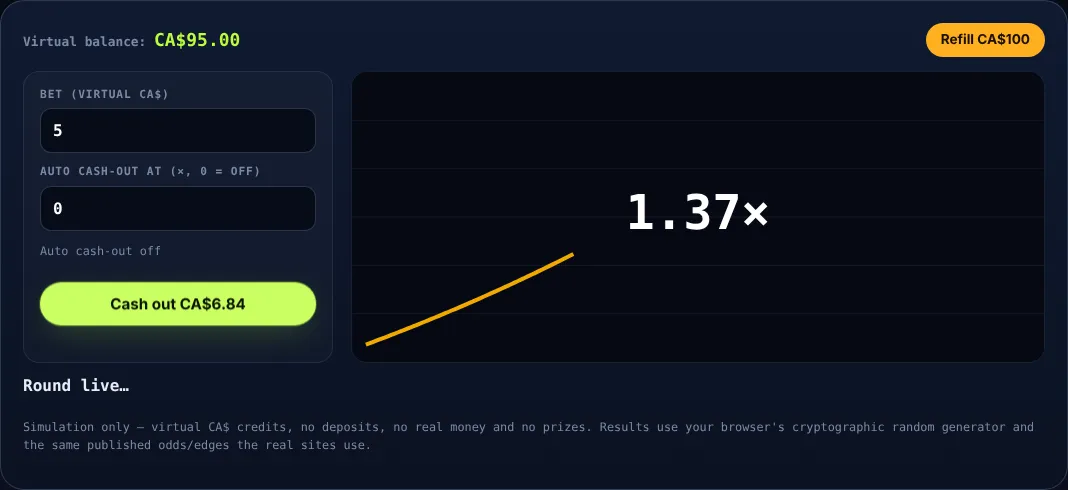
- Crash is high variance. Use the crash simulator before using real money.
Crash is the fastest-growing game on skin sites: a multiplier climbs from 1.00x and at some random point it crashes. If you cash out before the crash, you win your bet times the multiplier; if not, you lose it. It looks like a game of nerve, but under the hood it is a clean probability problem. Understanding it lets you choose a style that fits your budget and avoid common traps.
The maths of crash
Most crash games are built so that the chance of the multiplier reaching at least x is about 0.99 / x for a 1% house edge. Equivalently, about 1% of rounds crash instantly at 1.00x, and the rest follow a heavy-tailed distribution. The expected return of cashing out at x is the probability times the payout: (0.99/x) × x = 0.99, for any x.
| Cash-out target | Win probability (0.99/x) | Roughly 1 win in | Expected return per CA$1 |
|---|---|---|---|
| 1.20x | 82.5% | 1.2 | CA$0.99 |
| 1.50x | 66.0% | 1.5 | CA$0.99 |
| 2.00x | 49.5% | 2.0 | CA$0.99 |
| 3.00x | 33.0% | 3.0 | CA$0.99 |
| 5.00x | 19.8% | 5.1 | CA$0.99 |
| 10.00x | 9.9% | 10.1 | CA$0.99 |
| 100.00x | 0.99% | 101 | CA$0.99 |
Two lessons come directly from this table. First, there is no magic multiplier: all targets cost about 1% of the amount wagered. Second, the target controls the shape of your result, not the average. This is also why "chasing the moon" at 100x feels unlucky: you expect to lose 99 times in 100.
Check your site: Not every site uses exactly 1%. Some crash variants use higher edges, or they show a different instant-crash chance. Read the fairness page and verify results using provably fair tools.
Choosing a cash-out style
Low targets (1.2x to 1.6x)
You win often, so your balance rises in small steps and drops sharply on a loss. At 1.5x with a 66% win rate, a loss erases the profit from about two wins. Streak risk is modest: ten losses in a row has a probability of 0.3410, about 0.002%.
Medium targets (2x to 3x)
These are the most popular. At 2x, you win 49.5% of the time, and the longest losing streaks matter. The chance of ten consecutive losses is 0.50510, around 0.33%, or about 1 in 300 starts. Over a 200-round session, a ten-loss run is a real possibility.
High targets (5x+)
At 10x you win about 9.9% of rounds. A run of 30 losses has probability 0.90130, around 4.4%, so long losing stretches are normal. Use small stakes, because your sessions will often end in a net loss followed by an occasional big hit.
Streak table at 2x
| Consecutive losses | Probability from a given round | Cost if you double each time from CA$2 |
|---|---|---|
| 3 | 12.9% | CA$14 total |
| 5 | 3.3% | CA$62 total |
| 7 | 0.8% | CA$254 total |
| 10 | 0.33% | CA$2,046 total |
The right-hand column shows why Martingale is risky. The cost grows as 2n, while a lucky streak of wins adds only a small increment. A seven-loss streak happens about once in 120 rounds, which is routine for an active player.
Practical strategy rules
- Use auto cash-out. It removes delay and emotion, and means you decide your target before the round, not during it.
- Fix a unit size. Bet 1% to 2% of your session bankroll. On CA$150, that is CA$1.50 to CA$3.
- Pick one target per session. Switching after a loss often leads to chasing.
- Set a stop-loss (for example 30% of the session bankroll) and a win target.
- Limit the number of rounds. Each round costs 1% on average, so fewer rounds mean smaller expected loss.
- Review results. Log your wagered total and net result to see how close you are to the expected outcome.

Two-target and "split" bets
Some sites let you place two bets in the same round with different targets. For example, bet CA$2 at 1.5x and CA$1 at 5x. The first bet wins 66% of the time and returns CA$3; the second wins 19.8% of the time and returns CA$5. If both hit, you net CA$5; if only the first hits, you net CA$0; if neither, you lose CA$3. The mixture smooths the ride but each bet still has a 0.99 expected return, so the total remains at 0.99 per CA$ staked.
What does not work
- Pattern spotting. Previous crash points do not predict the next one.
- "Signals" and bots. Nobody can know the hashed result of a round that has not happened.
- Martingale. Doubling after each loss wins small amounts until it hits a streak or a limit.
- "Cold streak means big multiplier due." It is the gambler's fallacy; the next round is independent.
- Late cash-outs. Waiting "one more second" is just raising your target mid-round.
Speed, latency and the cost of volume
Crash rounds can run every 10 to 20 seconds. At that pace, 200 rounds takes under an hour. If you bet CA$5 per round, you wager CA$1,000 and lose about CA$10 in expectation at a 1% edge, a figure that would be CA$67 on 15-slot roulette. The low edge is only a benefit if you keep volume under control. Manual cash-outs also suffer from lag, since the round may crash between your click and the server receiving it, so auto cash-out gives a more predictable result.
Instant crashes at 1.00x are part of the model: about 1% of rounds. Your 1.2x target therefore has a loss rate of 17.5%, of which roughly 1% is instant. If you see many more instant crashes than that in a large sample, check the fairness page.
Bankroll examples in CA$
Suppose you have CA$100 for a session and choose a 2x target with CA$2 bets. Over 50 rounds you wager CA$100 and expect to lose about CA$1 from the edge, but the standard deviation of the result is far bigger, about CA$14 (each CA$2 bet has a standard deviation of roughly CA$2 at 2x, times the square root of 50). So an ordinary session ends anywhere from roughly CA$15 up to CA$15 down. If instead you bet CA$10 per round, the same distribution is five times wider, and your bankroll can vanish in a short run. Use the bankroll calculator to plan.
Crash versus other games
A 1% edge makes crash the cheapest per bet of the common games, far below 15-slot roulette at 6.67% (see our roulette strategy guide). But crash rounds are fast, so a player can wager much more per hour, and cost accumulates quickly. Our crash vs roulette article compares speed, edge and volatility. For sites with crash, see the CS2 gambling site rankings, including CSGORoll, 500Casino, Gamdom and Roobet.
Play responsibly. Crash is fast and can encourage chasing. Set time and money limits before you start, take breaks and never stake money you need. You must be 19+ (18+ in Alberta, Manitoba and Quebec). For support call ConnexOntario at 1-866-531-2600 or your provincial line, and see responsible gambling. New here? Start with How CS2 Gambling Works.
Frequently asked questions
What are the odds of reaching a given multiplier in crash?
With a 1% house edge model, the probability of reaching at least x is approximately 0.99/x. So 2x is about 49.5%, 10x about 9.9% and 100x about 0.99%.
Is there a best cash-out multiplier?
Not in terms of expected value: every target returns about 0.99 per dollar staked in a 1% edge game. Lower targets win more often with smaller payouts, higher targets win less often with larger ones.
Does auto cash-out help?
Yes for discipline. It removes reaction time and emotion, though it does not change the expected return.
Does the Martingale strategy work in crash?
No. Doubling after losses raises the size of rare large losses, and a long losing streak at 2x, though uncommon, happens often enough to destroy a bankroll.
Do all crash games have a 1% house edge?
No. Many are close to 1% but some use higher edges. Check the site's fairness or RTP page and your own results.
Play responsibly: CS2 gambling is for adults 19+ (18+ in AB, MB, QC). Set limits, never chase losses, and use self-exclusion if it stops being fun. Free, confidential help: ConnexOntario 1-866-531-2600 or your provincial helpline — see our responsible gambling page.