On this page ▾
- What skins are and why they work as money
- Coins: the site's internal currency
- The main game modes
- Where the games come from: provably fair
- Step by step: from signup to first bet
- Getting your money out
- The risks you should understand first
- Bankroll basics for newcomers
- Are free cases and bonuses really free?
- What to do next
- CS2 gambling uses skins (or coins/crypto bought with skins) as the stake instead of cash.
- Every mainstream game has a house edge, typically 1% to 7%, so the long-run expectation is a loss.
- The core loop is deposit, play, then withdraw skins, crypto or Interac-converted funds.
- Most sites are offshore and not licensed by Canadian provinces. Read our legal guide first.
- You must be 19+ (18+ in Alberta, Manitoba and Quebec). Set limits before your first deposit.
If you have ever wondered why your friends talk about "coins", "crash" and "Empire" while their CS2 inventory slowly changes, this guide is for you. We walk through exactly how skin gambling works from a Canadian point of view: where the value comes from, what the games are, how the maths favours the house, and what the practical steps look like from signup to cash-out.
What skins are and why they work as money
A CS2 skin is a cosmetic finish for a weapon, knife or glove. Skins do not change gameplay, but they can be traded on the Steam Community Market and between players. Because there is a deep market with visible prices, a skin behaves a lot like a tradable asset: a Redline AK-47 might be worth roughly CA$20 to CA$40, while a rare knife can run into the thousands. Prices move daily, so treat every figure you see as approximate.
Skin gambling sites exploit that liquidity. Instead of asking you to pay with a bank card, they accept your skins through a trade offer, price them against a market index, and credit your account with a balance. That balance is spent on games and, if you are lucky, grows. When you leave, you convert it back to skins or crypto.
Coins: the site's internal currency
Most skin sites use coins rather than dollars. A coin is just an accounting unit, and each site sets its own value. On CSGOEmpire, for example, the Free Case is advertised as worth up to 2,050 coins. Our coins to CA$ converter helps you translate a site's coin balance into approximate Canadian dollars so you always know what you are really risking.
Two points matter here. First, coin pricing of your skins often includes a small markup or discount compared with the Steam Market, so the same skin can be worth a little more or less depending on the site. Second, coins are only worth what the site lets you withdraw them for, so always check the withdrawal options before you deposit.
The main game modes
Almost every site offers the same handful of games, with slightly different branding. Understanding the maths of each is the single most useful thing a beginner can do.
| Game | How it works | Typical house edge | Volatility |
|---|---|---|---|
| Roulette (red/black/green) | Bet on a coloured outcome from a 15-slot wheel (7 red, 7 black, 1 green) | About 6.67% on red/black and green | Medium |
| Crash | A multiplier climbs until it crashes; cash out before it does | Commonly 1% to 5% | High |
| Case opening | Pay a price to open a case with a weighted item table | Varies by case, often 5% to 15%+ | High |
| Coinflip | Two players stake skins, winner takes the pot minus a fee | Roughly 5% to 10% fee on the pot | Medium |
| Case battles | Players open the same cases; the highest total value wins | Built into case pricing and fees | High |
| Mines / dice / upgrader | Choose your own risk level against a fixed payout curve | Usually 1% to 5% | Adjustable |
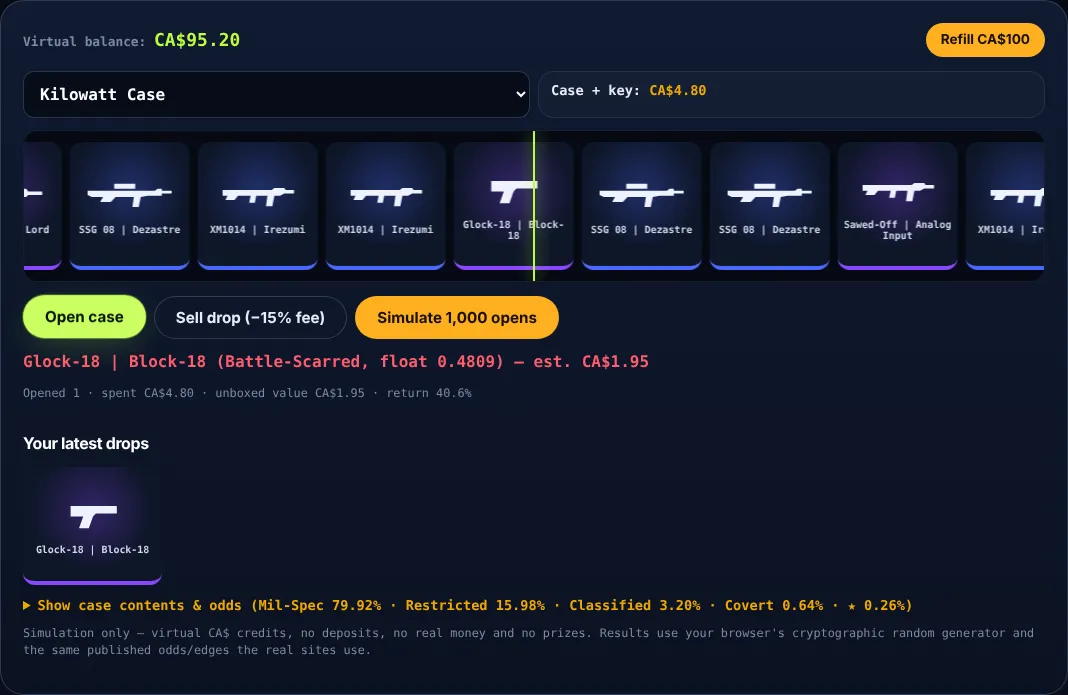
You can try the mechanics risk-free in our roulette simulator, crash simulator and case opening simulator. They use the same standard odds we describe in our case opening odds guide.
A quick worked example of the house edge
Suppose you bet CA$10 on red in 15-slot roulette. Red wins 7 times out of 15, which is 46.67%, and pays 2x. Your expected return is 0.4667 × CA$20 = CA$9.33. The expected loss is CA$0.67 per CA$10 staked, which is the 6.67% house edge. Over thousands of bets that edge is what funds the site. No betting system changes it.
Where the games come from: provably fair
Reputable sites publish their results using a "provably fair" system, where a hashed server seed is committed before the round and revealed afterwards so you can check the outcome was not changed. It does not make the game fair in the sense of favouring you, it only proves the site did not cheat mid-round. We explain the maths in Provably Fair Explained.
Step by step: from signup to first bet
- Check legality and age. You need to be 19+ in most provinces, or 18+ in Alberta, Manitoba and Quebec.
- Pick a site. Compare options in our ranking of CS2 gambling sites in Canada and read how we score them on How We Rate.
- Sign in with Steam. The site uses Steam OpenID, so you never give it your Steam password. Create the account, then switch on two-factor authentication.
- Claim any free offer. Promo codes unlock free cases or bonuses; check all promo codes.
- Set your Steam trade URL so the site can send you items. See Steam Trade URL and API Key.
- Deposit. Send skins or buy crypto, following How to Deposit Skins.
- Set limits. Decide a session budget in CA$ before you play and stick to it.

Getting your money out
This is where beginners often get surprised. You cannot usually withdraw coins straight to a Canadian bank account. The common routes are: withdraw skins to your Steam inventory and sell them; withdraw crypto and sell it on a FINTRAC-registered exchange; or use a peer-to-peer marketplace. From the exchange you can send an Interac e-Transfer to a bank such as RBC, TD, Scotiabank, BMO or CIBC. Our withdrawal guide covers fees and timing in detail.
The risks you should understand first
Warning: Gambling can become a problem quickly. Never stake skins or money you cannot afford to lose, and never chase losses. If gambling stops being fun, contact ConnexOntario (1-866-531-2600) or your provincial helpline, and consider self-exclusion on any site you use.
- House edge. The maths is against you on every bet. Rakeback and bonuses soften this but rarely erase it. See our rakeback calculator.
- Regulatory risk. Offshore operators are not licensed by Ontario or other Canadian regulators, so provincial consumer protections do not apply.
- Scams. Fake sites, phishing links and API-key theft are common. Read our post on avoiding skin site scams.
- Trade protection. Valve's trade protection means some traded items may be reversible for a period. We explain it cautiously in Steam trade protection explained.
- Tax. Selling crypto can trigger capital gains. Details in our tax guide.
Bankroll basics for newcomers
A simple rule is to split your balance into sessions and never bet more than 1% to 2% of it on a single round. If you start with CA$100, that is CA$1 to CA$2 per bet. It sounds slow, but it keeps variance survivable. The bankroll calculator and our post on bankroll management go deeper.
Tip: Treat your starting balance as the price of entertainment, like a movie ticket. If you finish the evening with more, great; if not, you have spent what you planned to spend.
Are free cases and bonuses really free?
Free cases are usually genuine, but they often come with wagering conditions or a daily cap on what can be withdrawn. Deposit bonuses typically require you to wager a multiple of the bonus before it unlocks. Always read the terms and use our wagering calculator to see what you need to play through. The advertised value is a headline, not a guarantee.
What to do next
Start by learning the maths, then choose one game and master its odds before moving to others. Read about roulette strategy and crash strategy to see what planning can and cannot do. Finally, review our responsible gambling page. This content is for information only and is not financial or legal advice; gamble responsibly and only if you are of legal age in your province.
Frequently asked questions
What is CS2 gambling?
It means wagering Counter-Strike 2 skins, or coins and crypto bought with them, on games such as roulette, crash, case opening and coinflip. The skins act as the currency instead of cash.
Do I need to own expensive skins to start?
No. Many Canadians begin with a CA$5 to CA$20 skin or a small crypto deposit. Free cases and promo codes can also give you a starting balance without any deposit.
Can I actually make money gambling on CS2 sites?
Every game has a built-in house edge, so the expected result over time is a loss. Short-term wins are possible, but you should treat any money you stake as entertainment spending.
What are coins on a skin gambling site?
Coins are the site's internal balance. You get them by depositing skins or crypto, and you can later convert them back to skins or crypto, usually at a rate shown on the site.
Is it safe for Canadians to use these sites?
Safety varies by operator. Stick to established sites, enable two-factor authentication, never share your Steam API key, and read our legal guide because most are offshore and unlicensed in Canada.
Play responsibly: CS2 gambling is for adults 19+ (18+ in AB, MB, QC). Set limits, never chase losses, and use self-exclusion if it stops being fun. Free, confidential help: ConnexOntario 1-866-531-2600 or your provincial helpline — see our responsible gambling page.