
On this page ▾
- A case battle is a group case opening where total value decides who wins the pot.
- The format adds excitement and variance, not better expected value. The house edge is unchanged.
- Common modes: standard (highest total wins), reverse (lowest total wins), and team formats.
- Start with a free case or small stakes and cap your spending per session.
What is a case battle?
Normal case opening is a solo activity: pay for a case, open it, get an item. In a case battle, two or more players pay the same entry and open an identical list of cases at the same time. The values of everything each player pulls are added, and the winner takes the combined items, or a share of them, depending on the mode. CSGORoll is the platform best known for the format.
A round in four steps
- A player creates a battle: chooses cases, number of players and mode.
- Others join and pay the same entry cost.
- All players open each case in sync, with the animations playing side by side.
- Totals are compared and the pot is awarded.
Common modes
| Mode | Who wins | Risk feel | Best for |
|---|---|---|---|
| Standard 1v1 | Highest total takes everything | Roughly even split of outcomes, minus the edge | Beginners |
| Multi-player (3 to 6) | Highest total takes everything | Lower win chance, bigger pot | Lottery-style fun |
| Reverse (low wins) | Lowest total takes the pot | Odd, rewards bad luck | Variety |
| Team battles | Combined team total wins | Shared risk and reward | Playing with friends |
| Share modes | Pot split by rule | Smoother outcomes | Lower volatility |
Names and rules vary from site to site, so read the mode description before joining.
The maths behind the fun
The key insight is that a battle is just several case openings with a winner-takes-all twist. If the cases return, on average, 90% of their cost in item value (an illustrative figure; sites publish their own), then a two-player battle on CA$20 of cases each puts CA$40 in, pulls about CA$36 in expected item value, and gives the winner the lot. Each player's expected return is still about 90%, with the 10% going to the house. Winner-takes-all just makes the variance bigger.
| Scenario (illustrative) | Entry each | Pot value (expected) | Your expected return |
|---|---|---|---|
| 1v1, 90% return cases | CA$20 | CA$36 | CA$18 (90%) |
| 4-player, 90% return cases | CA$20 | CA$72 | CA$18 (90%) |
| 1v1, 95% return cases | CA$20 | CA$38 | CA$19 (95%) |
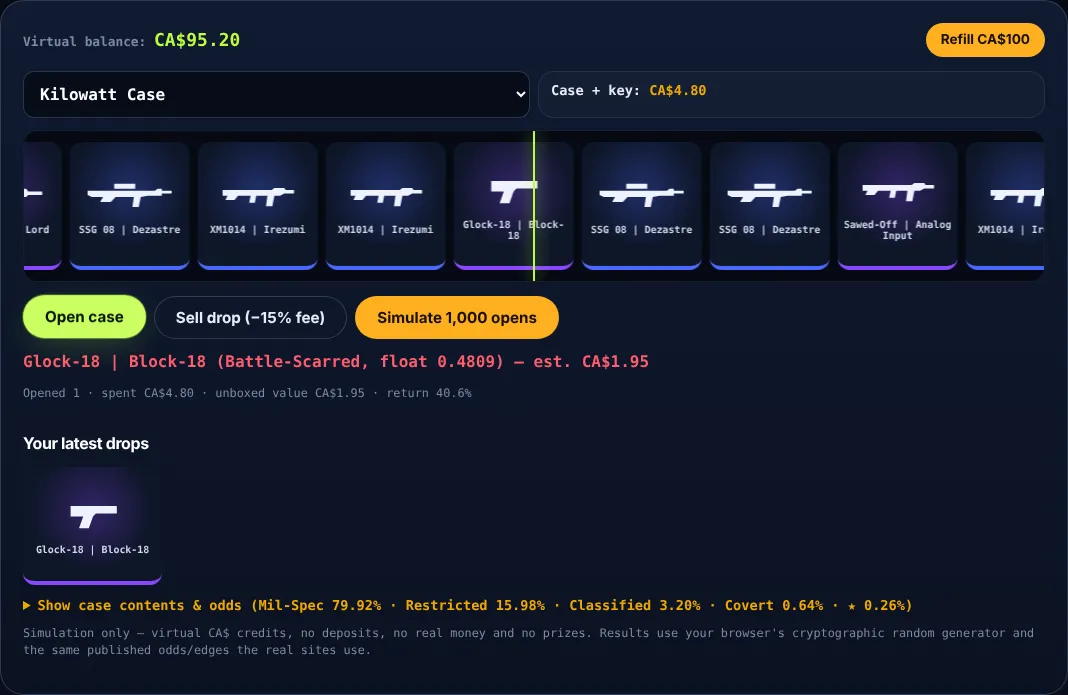
Notice that player count does not change your expected return; it changes how often you win and how big the win is. To see the odds under the hood, read our case opening odds guide and test in the case opening simulator.
Strategy that actually helps
1. Choose cases by volatility
Cases with a few big prizes and many low items produce swingy totals. Cases with more even pools give tighter results. If you want a coin-flip feel in a 1v1, pick even pools; if you want a shot at a jackpot, pick high-variance cases.
2. Match mode to your goal
Want to preserve balance? Share or team modes smooth things. Want a thrill? Winner-takes-all.
3. Watch fees and prices
Compare case prices with their item pools. A case with a more favourable return is better than one with a flashy name.
4. Set a battle budget
Because battles are fast, it is easy to run through ten in a few minutes. Decide your cap first. See bankroll management for a framework.
Beginner mistakes
- Assuming a recent loss means you are "due" to win.
- Creating expensive battles to chase a previous loss.
- Ignoring the pool and picking cases only by price.
- Not checking if the battle includes bots or fixed items; read the rules.
Try before you buy: CSGORoll's code BONUSBOX gives 3 Free Cases and a 5% deposit bonus, which is a low-cost way to see how a battle plays out.

Fairness and verification
Battle outcomes come from provably fair seeds, so each case pull can be checked after the fact. We explain the idea in provably fair explained. Not all sites use identical systems, so read each site's rules.
Case battles vs other modes
| Aspect | Case battle | Solo case opening | Roulette |
|---|---|---|---|
| Social | High | Low | Medium |
| Variance | High | Medium to high | Medium |
| Skill | Mode and case choice only | None | None |
| Typical edge | Site specific | Site specific | 6.67% (15-slot) |
Compare with crash vs roulette if you are weighing different games.
A worked battle example
Imagine a 1v1 battle with three cases that each cost CA$5. Each player pays CA$15 and opens three cases. Player A pulls items worth CA$2, CA$1 and CA$30, a total of CA$33. Player B pulls CA$6, CA$4 and CA$8, a total of CA$18. Player A wins the pot of six items, worth CA$51, for a CA$15 stake. It looks lucrative, but that outcome depended on one lucky pull. Across many battles, you would also lose many times, and the sites' margin is built into case prices.
How to choose a battle size
| Budget per battle | Suggested approach |
|---|---|
| Under CA$5 | Single cheap case, 1v1; good for learning |
| CA$5 to CA$20 | Two or three mid-priced cases; check pool spread |
| CA$20 and over | Only with a clear session cap and after the basics are familiar |
Reading a case pool
Before you join, open the case details. Look at the highest-value items and their chances, and compare them to the cost of the case. A case with one huge item at a tiny probability and many cheap skins will produce lopsided totals, so battles in it are mostly decided by whether someone hits the jackpot. A case with a tighter range will give closer battles. Neither is "better"; they simply suit different moods.
Etiquette and social side
Case battles are partly social. Be respectful in chat, avoid teasing someone who lost, and do not pressure friends into joining bigger battles than they want. If you notice a friend chasing losses, step in kindly. The best part of battles is the shared fun, not the pot.
Summary
Case battles are a fun social twist on case opening, but the maths under the hood is the same. Choose cases and modes that match how much variance you want, keep a budget and treat every result as entertainment.
Frequently asked questions
What is a case battle?
Two or more players open the same set of cases at the same time. Depending on the mode, the highest total value wins all or the items are split.
Do case battles have better odds than normal case opening?
The battle format does not change the item odds. You still face the house edge built into the case prices and pools.
What is a crazy or reverse mode?
In reverse or underdog-style modes, the lowest total wins instead of the highest. Names and rules vary by site.
Which sites offer case battles?
CSGORoll is best known for them. Other platforms may offer similar modes.
Can I practise case battles for free?
You can practise case openings in our simulator and use free cases from welcome offers.
Play responsibly: CS2 gambling is for adults 19+ (18+ in AB, MB, QC). Set limits, never chase losses, and use self-exclusion if it stops being fun. Free, confidential help: ConnexOntario 1-866-531-2600 or your provincial helpline — see our responsible gambling page.
Related reading
Crash vs Roulette: Which CS2 Game Fits Your Style?
Both games look simple, but they behave very differently. We compare odds, volatility and decision-making to help you choose.
Read article →
CSGOEmpire Roulette Tips: 9 Smart Habits for Canadians
Roulette is a pure game of chance, but your habits are not. Here are nine practical tips for playing CSGOEmpire roulette more sensibly.
Read article →
CSGOFast Game Modes: Crash, Double, X50, Poggi and More
CSGOFast packs many modes into one site. We rank them by risk, explain how each works and show where the free case and 10% deposit bonus fit in.
Read article →